Daily Cloud Blog • Virtualization • Infrastructure Strategy
OpenShift Virtualization vs Proxmox VE
A practical breakdown of how these two platforms differ, where each one fits best, and what IT teams should consider before choosing a direction.
Author
Daily Cloud Blog Editorial Team
Published
March 6, 2026
Read Time
7 min read
As organizations modernize their infrastructure, virtualization platforms are evolving beyond traditional hypervisors. Two technologies often compared in modern environments are OpenShift Virtualization and Proxmox VE (Proxmox Virtual Environment).
While both platforms allow organizations to run virtual machines, they are built with different architectural philosophies and operational goals.
Understanding these differences helps IT teams choose the right platform depending on whether they are prioritizing cloud-native workloads, container integration, simplicity, scalability, or cost efficiency.
What is OpenShift Virtualization?
OpenShift Virtualization is a virtualization capability built into the Kubernetes-based OpenShift platform using the KubeVirt project.
Instead of running virtual machines on a traditional hypervisor stack alone, OpenShift Virtualization allows organizations to run VMs as Kubernetes-managed resources alongside containers.
Key Characteristics
1. Kubernetes-Native Virtual Machines
VMs run inside Kubernetes clusters, which makes it possible to manage both virtual machines and containerized workloads together in a unified platform.
2. Hybrid VM + Container Platform
Organizations can use OpenShift Virtualization to support:
- Containerized applications
- Traditional virtual machines
- Hybrid modernization strategies
3. Strong Cloud-Native Integration
It fits naturally into modern platform operations such as:
- CI/CD pipelines
- GitOps workflows
- Infrastructure automation
- Kubernetes-native networking and storage
4. Enterprise-Oriented Platform
OpenShift Virtualization is often aimed at enterprises building standardized platforms for hybrid cloud, multi-cluster operations, and modern application delivery.
Typical Use Cases
- Modernizing legacy workloads
- Running VMs and containers on one platform
- Gradually migrating traditional apps toward Kubernetes
- Enterprise platform engineering initiatives
What is Proxmox VE?
Proxmox Virtual Environment (VE) is an open-source virtualization platform built on:
- KVM for virtual machines
- LXC for lightweight containers
Proxmox follows a more traditional hypervisor model, similar in concept to VMware-style virtualization, while also offering an integrated management experience with clustering, storage, backups, and high availability features.
Key Characteristics
1. Traditional Virtualization Architecture
Proxmox runs directly on bare metal servers and uses KVM to host virtual machines in a familiar hypervisor-based design.
2. Built-In Web Management
Proxmox includes a clean web interface for common operational tasks such as:
- VM provisioning and management
- Storage configuration
- Cluster administration
- Backup and restore operations
3. Cost-Effective and Lightweight
One of Proxmox’s biggest strengths is that it offers strong virtualization capabilities without the licensing costs many teams associate with legacy enterprise virtualization platforms.
4. Practical Infrastructure Features
Proxmox includes features such as:
- Live migration
- High availability clustering
- Integrated backups
- Ceph support for software-defined storage
Typical Use Cases
- Traditional VM infrastructure
- Home labs and test environments
- Small and mid-sized business deployments
- Cost-conscious VMware alternative projects
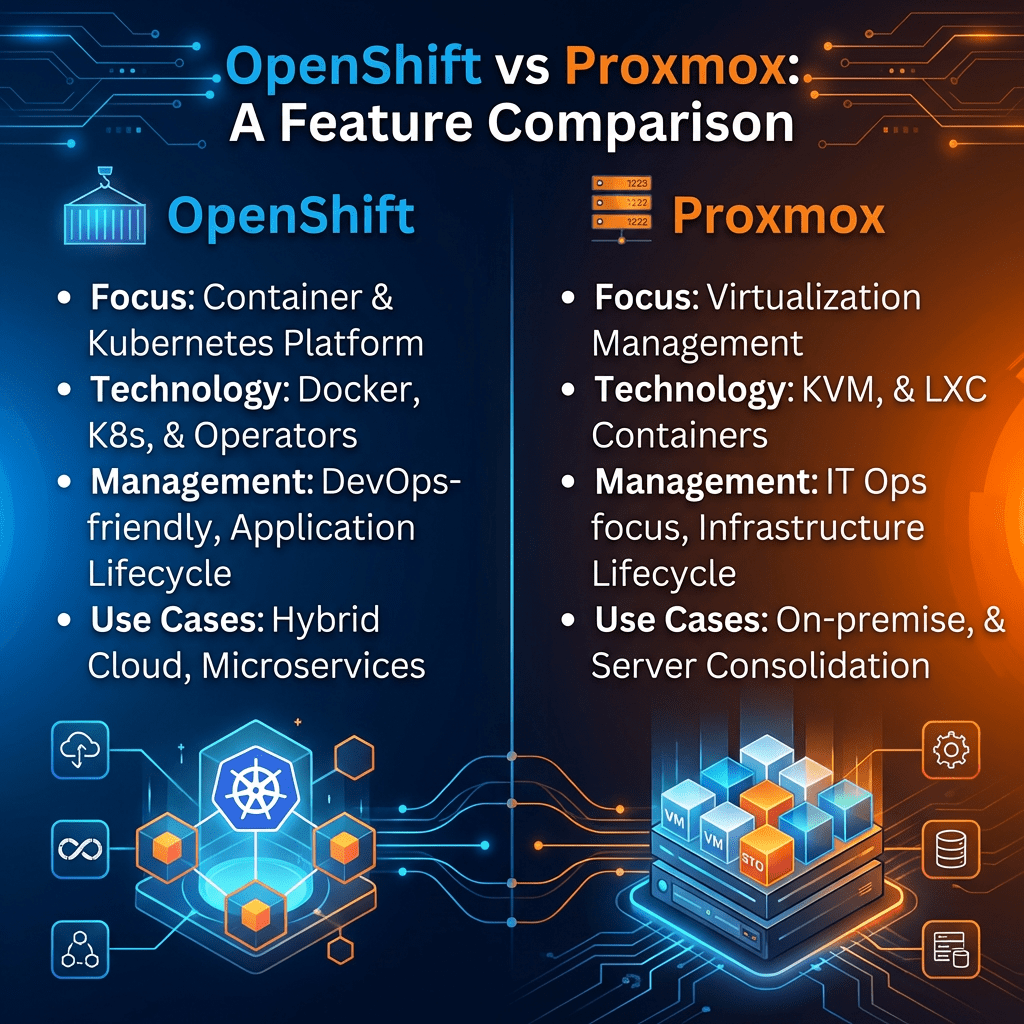
OpenShift Virtualization vs Proxmox: Key Differences
| Feature | OpenShift Virtualization | Proxmox VE |
|---|---|---|
| Core Platform | Kubernetes-based platform | Traditional hypervisor platform |
| VM Technology | KubeVirt | KVM |
| Container Approach | Native Kubernetes containers | LXC containers |
| Best Fit | Cloud-native and hybrid modernization | Traditional VM hosting and lab environments |
| Operational Complexity | Higher due to Kubernetes ecosystem | Lower and easier to adopt |
| Automation Style | GitOps, CI/CD, platform automation | Traditional admin workflows and API-based automation |
| Cost Model | Enterprise subscription model | Open-source with optional support subscription |
Architecture Comparison
OpenShift Virtualization Architecture
Applications
   │
Containers + Virtual Machines
   │
OpenShift / Kubernetes
   │
KubeVirt Virtualization Layer
   │
Worker Nodes
   │
Bare Metal Infrastructure
Proxmox VE Architecture
Applications
   │
Virtual Machines / LXC Containers
   │
Proxmox Management Layer
   │
KVM Hypervisor
   │
Linux OS
   │
Bare Metal Infrastructure
When Should You Use OpenShift Virtualization?
OpenShift Virtualization makes the most sense when your organization is:
- Building a cloud-native platform strategy
- Running both containers and VMs together
- Standardizing around Kubernetes
- Adopting DevOps and GitOps workflows at scale
It is especially valuable when infrastructure teams are trying to reduce platform sprawl and unify operations around a modern application platform.
When Should You Use Proxmox?
Proxmox is a strong choice when you want:
- A simpler virtualization platform
- A cost-effective VMware alternative
- A traditional VM-first operating model
- A fast and practical deployment for labs or production
For organizations that do not need deep Kubernetes integration, Proxmox often delivers excellent value with less complexity.
Final Thoughts
Both OpenShift Virtualization and Proxmox are capable platforms, but they solve different problems.
OpenShift Virtualization is about bringing virtual machines into a broader Kubernetes and cloud-native operating model.
Proxmox VE is about delivering dependable, flexible, and affordable virtualization in a more traditional way.
The better choice depends less on feature checklists and more on your operational direction. If your team is moving toward platform engineering, GitOps, and container-first operations, OpenShift Virtualization may be the better long-term fit. If your team mainly needs efficient VM hosting with straightforward management, Proxmox may be the better answer.
Key Takeaway
Choose OpenShift Virtualization if you are building around Kubernetes, automation, and cloud-native modernization.
Choose Proxmox VE if you want a simple, powerful, and budget-friendly virtualization platform for traditional VM workloads.
Stay Connected with Daily Cloud Blog
If you found this comparison helpful, follow Daily Cloud Blog for more practical content on cloud, virtualization, DevOps, cybersecurity, and infrastructure strategy.
We regularly share technical breakdowns, architecture guidance, and real-world insights designed for engineers, architects, and IT leaders.
Want more posts like this? Subscribe for fresh content on AWS, Azure, Kubernetes, virtualization, and modern infrastructure trends.
About Daily Cloud Blog
Daily Cloud Blog shares practical insights on cloud, virtualization, infrastructure, and modern IT strategy for engineers, architects, and technology leaders.



 My Daily Cloud Blog
Leave a comment