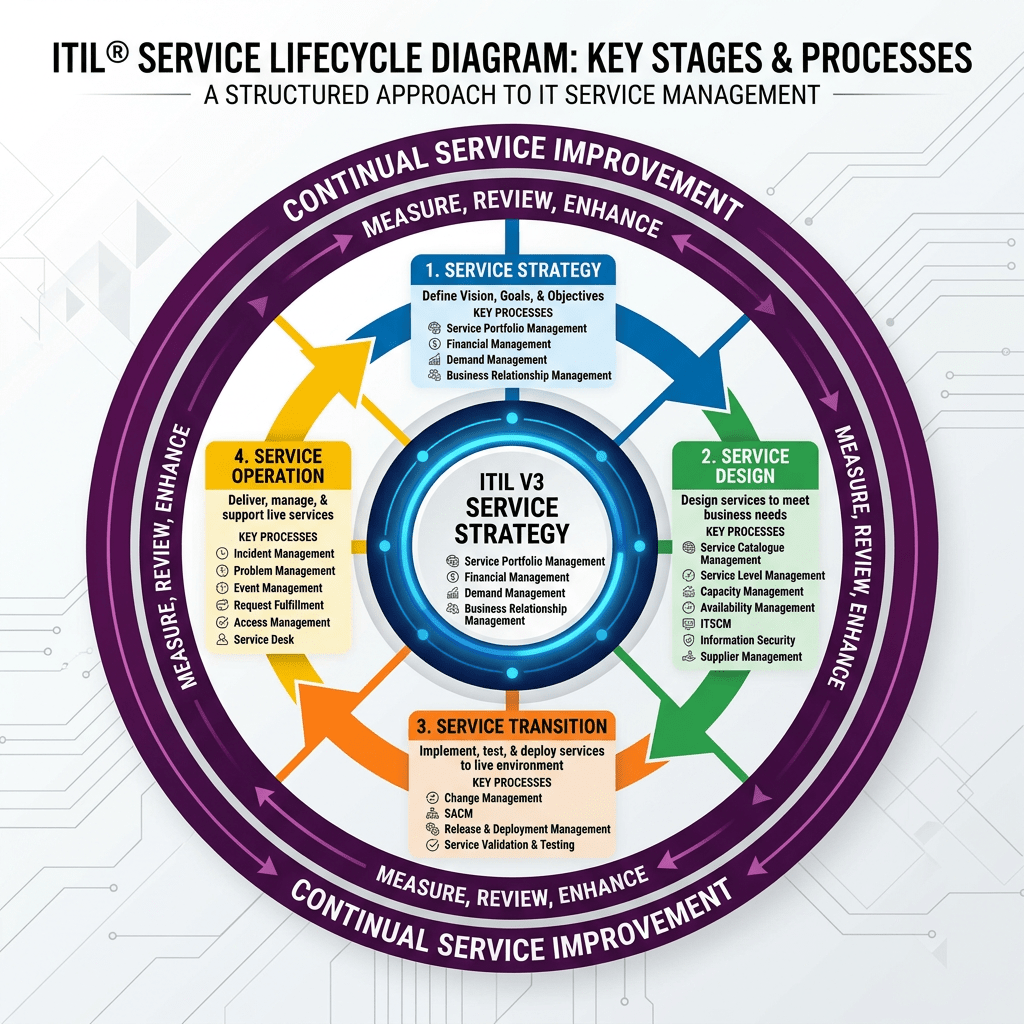
IT Service Management | Operations | Governance
ITIL Overview: Understanding the Framework Behind Modern IT Service Management
A practical introduction to ITIL 4, the Service Value System, the Service Value Chain, guiding principles, and why the framework still matters in modern IT operations and digital transformation.
In modern IT environments, success is no longer measured only by whether infrastructure is running or tickets are being closed. Organizations are expected to deliver reliable services, improve user experience, support business outcomes, and adapt quickly to change. That is exactly why frameworks like ITIL continue to play such an important role in IT operations and service management.
ITIL is one of the most recognized frameworks for IT service management. It provides organizations with practical guidance for creating, delivering, supporting, and continually improving services. Rather than focusing only on technology, ITIL helps teams think in terms of value, outcomes, governance, collaboration, and continuous improvement.
Whether an organization is improving help desk operations, modernizing service delivery, aligning IT with business needs, or building a more mature operational model, ITIL offers a structured approach to make service management more effective.
Key idea: ITIL helps organizations shift from managing isolated IT activities to delivering services that create real business and customer value.
What is ITIL?
ITIL is a service management framework that provides best-practice guidance for how organizations design, deliver, support, and improve services. It gives IT teams a structured way to think about workflows, customer needs, operational consistency, governance, and ongoing service improvement.
At a practical level, ITIL helps answer questions such as:
- How do we design services that actually create value?
- How should teams handle service delivery, support, and change?
- How can IT work more closely with the business and end users?
- How do we measure performance and improve over time?
- How can governance and flexibility exist together in the same operating model?
Why ITIL Matters
Many organizations struggle with inconsistent support processes, poor visibility, siloed operational teams, unclear ownership, and service experiences that frustrate both users and the business. ITIL helps reduce that confusion by offering a framework for managing services in a more disciplined and outcome-oriented way.
In short, ITIL matters because it helps organizations treat IT as a service provider, not just a technical function. It encourages better alignment between operations, customer expectations, governance, and business value.
ITIL 4 and the Modern Service Management Model
The current version in broad use is ITIL 4, which introduced a more modern and flexible model for service management. ITIL 4 places strong emphasis on value co-creation, adaptability, governance, continual improvement, and integration with modern ways of working such as Agile, DevOps, and digital transformation initiatives.
Instead of viewing service management as a rigid set of isolated processes, ITIL 4 presents service delivery as a connected system built around value.
The Core of ITIL 4: The Service Value System (SVS)
One of the most important concepts in ITIL 4 is the Service Value System, or SVS. The SVS explains how the different parts of an organization work together to enable value creation through services.
Rather than focusing only on a service desk or a single operational workflow, the SVS provides a broader model that connects:
- Guiding principles
- Governance
- The service value chain
- Management practices
- Continual improvement
The Service Value Chain
At the center of the Service Value System is the Service Value Chain. This is the operating model that shows how demand is turned into value through key organizational activities.
The six value chain activities are:
Plan
Ensures a shared understanding of direction, priorities, and improvement opportunities.
Improve
Supports continual improvement across services, practices, and all service value chain activities.
Engage
Maintains relationships with stakeholders and ensures their needs and expectations are understood.
Design & Transition
Ensures products and services meet stakeholder expectations for quality, cost, and time-to-market.
Obtain / Build
Delivers service components when and where they are needed, including development, sourcing, and configuration.
Deliver & Support
Ensures services are delivered and supported according to agreed specifications and user expectations.
The Seven Guiding Principles of ITIL 4
ITIL 4 includes seven guiding principles that help teams make better decisions in different situations. These are meant to be broadly applicable, regardless of the specific technology stack, organization size, or operating model.
- Focus on value
- Start where you are
- Progress iteratively with feedback
- Collaborate and promote visibility
- Think and work holistically
- Keep it simple and practical
- Optimize and automate
The Four Dimensions of Service Management
ITIL 4 also emphasizes four dimensions of service management. These dimensions help organizations avoid focusing too narrowly on only one part of service delivery.
Organizations and People
Focuses on culture, roles, skills, team structures, and communication needed to support effective service management.
Information and Technology
Covers the data, tools, automation, systems, and technology capabilities needed to enable services.
Partners and Suppliers
Recognizes that modern service delivery often depends on third parties, vendors, and strategic partner ecosystems.
Value Streams and Processes
Focuses on workflows, activities, controls, and how work moves across the organization to deliver outcomes.
ITIL Practices in the Real World
ITIL 4 uses the concept of management practices rather than treating everything as a traditional process library. This is a more flexible and modern way to frame service management.
In real environments, teams often apply ITIL guidance through areas such as:
- Incident management
- Problem management
- Change enablement
- Service desk operations
- Service level management
- Continual improvement
- Monitoring and event management
- Knowledge management
What Makes ITIL Useful in Practice?
ITIL helps organizations bring structure to service delivery without losing sight of outcomes. It can improve consistency, clarify accountability, reduce operational noise, and create a stronger link between technical activities and business expectations.
It is especially useful for organizations that want to improve service quality, standardize support operations, build stronger governance, and create a culture of continual improvement.
Common ITIL Challenges
Like any framework, ITIL can be misunderstood or overcomplicated. One of the most common mistakes is treating it like a rigid compliance checklist instead of a practical guide for service improvement.
ITIL works best when it is adapted to the organization’s size, maturity, culture, and goals. The framework should enable better service management, not create unnecessary process overhead.
Why ITIL Still Matters in Modern IT
In cloud-first, fast-moving environments, some teams assume traditional service management frameworks are outdated. But the reality is that modern IT still needs reliability, governance, change coordination, support maturity, and clear accountability.
ITIL remains relevant because it provides a strong operating foundation for service management while still allowing teams to integrate modern practices such as Agile delivery, DevOps collaboration, automation, and platform-based operations.
Who Should Learn ITIL?
ITIL is valuable for service desk analysts, operations teams, infrastructure engineers, support leads, IT managers, service delivery managers, and technology leaders who need to improve how services are delivered and supported.
It is especially useful for professionals working in environments where reliability, user experience, governance, and continuous operational improvement matter.
Final Thoughts
ITIL remains one of the most recognized frameworks in IT service management because it helps organizations think beyond isolated tickets, tools, and operational tasks. It creates a more structured way to design, deliver, support, and improve services with value at the center.
Whether the goal is improving support maturity, aligning IT with the business, building stronger operational governance, or delivering better service experiences, ITIL provides a strong foundation for modern service management.
Bottom Line
ITIL is not just about ticketing or service desk process. It is a framework for building reliable, value-driven, and continually improving IT services across the enterprise.
Continue the Service Management Conversation
If you are exploring IT operations, service delivery, governance, cloud operations, or modern infrastructure management, follow Daily Cloud Blog for more practical breakdowns focused on modern IT and enterprise transformation.
Read more articles, share this post with your operations team, and stay connected for more IT leadership insights.


Leave a Reply