Microsoft Azure | Hybrid Cloud | Multi-Cloud | Infrastructure
Azure Arc: A Deep Dive into Hybrid and Multi-Cloud Management
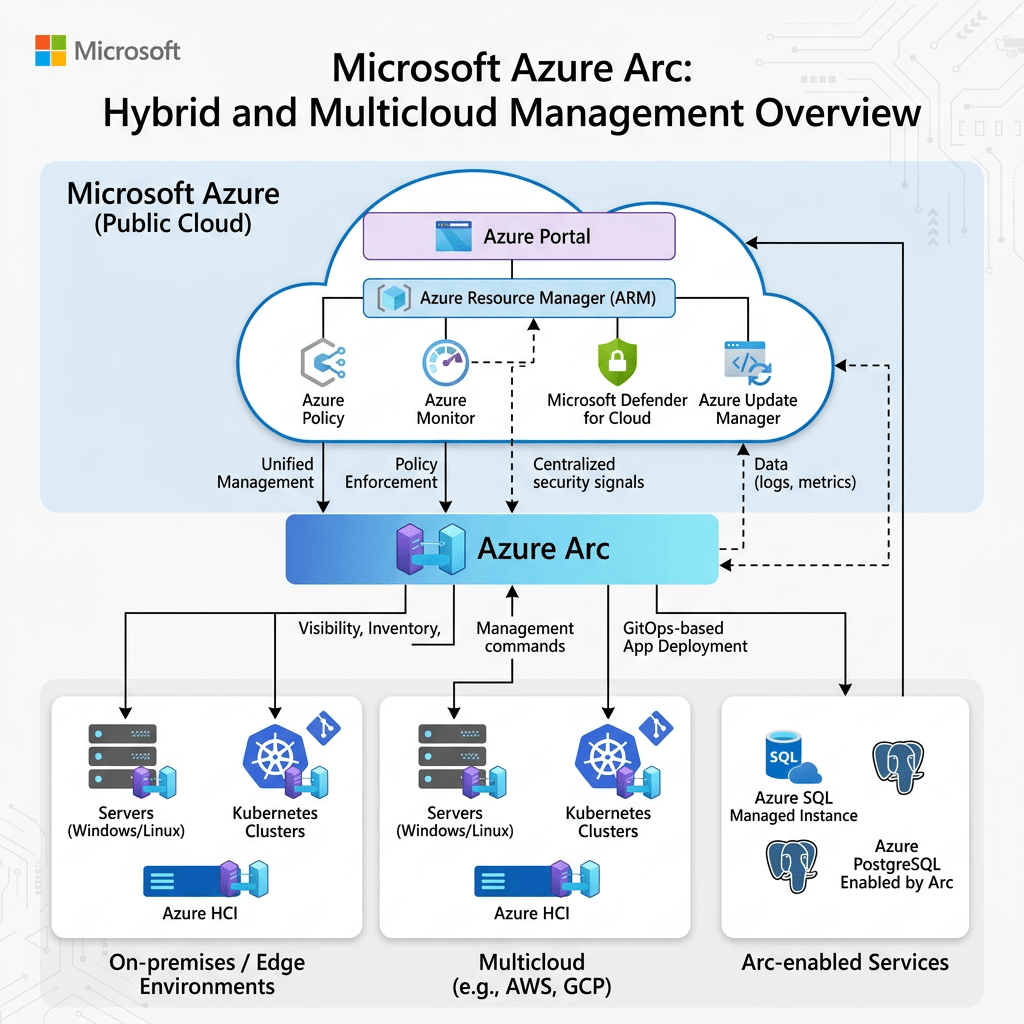
Azure Arc extends Azure management and services beyond the cloud, allowing organizations to manage servers, Kubernetes clusters, and applications across on-premises, multi-cloud, and edge environments using a single control plane.
Author: Christian Marrero
Blog: Daily Cloud Blog
Topic: Azure Arc Overview
Microsoft Azure Arc
Hybrid Cloud • Multi-Cloud • Governance • Kubernetes • Servers • Data Services • Azure Control Plane
What Is Azure Arc?
Azure Arc is a set of technologies that brings Azure management and services to infrastructure running outside of Azure. This includes on-premises data centers, other cloud providers such as AWS and Google Cloud, and edge environments.
Instead of forcing all workloads into Azure, Azure Arc allows organizations to project their existing resources into Azure as manageable objects. Once connected, these resources can be governed, secured, and operated using Azure-native tools.
Daily Cloud Blog Take: Azure Arc is not about moving workloads — it’s about extending Azure’s control plane to wherever your workloads already live.
Why Azure Arc Matters
Modern enterprise environments are no longer confined to a single data center or cloud provider. Organizations operate across hybrid environments, multiple clouds, remote sites, and edge locations.
This creates operational complexity, inconsistent security policies, fragmented visibility, and management overhead. Azure Arc solves this by centralizing control through Azure.
With Azure Arc, you can manage distributed infrastructure using a consistent set of tools, policies, and automation frameworks.
Core Azure Arc Capabilities
Key Features
- Manage on-premises and multi-cloud servers
- Govern Kubernetes clusters anywhere
- Apply Azure Policy and compliance controls
- Enable Azure Monitor and Defender for Cloud
- Deploy Azure data services outside Azure
- Use GitOps for Kubernetes configuration
- Extend RBAC and identity controls via Entra ID
Azure Arc for Servers
Azure Arc allows you to onboard physical and virtual servers running outside Azure into Azure Resource Manager. Once connected, these servers appear as Azure resources and can be managed using familiar Azure tools.
This includes applying tags, policies, monitoring, security baselines, and automation scripts across all environments consistently.
Whether your servers run in AWS, VMware, Nutanix, or physical infrastructure, Azure Arc gives you a unified management layer.
Azure Arc for Kubernetes
Kubernetes is a core part of modern application platforms, and Azure Arc extends management capabilities to any CNCF-certified Kubernetes cluster.
This includes clusters running on-premises, in other clouds, or even at the edge. Azure Arc enables centralized governance, policy enforcement, monitoring, and application deployment through GitOps.
This allows organizations to standardize Kubernetes operations without locking into a single cloud provider.
Key Advantage: Azure Arc enables GitOps-driven deployments, allowing infrastructure and application configurations to be defined as code and automatically enforced across clusters.
Azure Arc-Enabled Data Services
Azure Arc also brings Azure data services such as Azure SQL Managed Instance and PostgreSQL Hyperscale to on-premises and multi-cloud environments.
These services run on Kubernetes but are managed through Azure, providing cloud-like capabilities such as scaling, monitoring, patching, and automation without requiring workloads to reside in Azure.
This is especially valuable for organizations with data residency, latency, or regulatory requirements.
Governance and Compliance
One of the strongest benefits of Azure Arc is governance. Organizations can apply Azure Policy across all resources, regardless of location.
This ensures consistent compliance, configuration standards, and security baselines across hybrid and multi-cloud environments.
Instead of managing policies separately in each platform, Azure Arc allows centralized policy enforcement through Azure.
Governance Capabilities
- Azure Policy enforcement across environments
- Tagging and resource organization
- Compliance reporting and auditing
- Standardized configuration management
- Security baseline enforcement
Security with Azure Arc
Azure Arc integrates with Microsoft Defender for Cloud, enabling security monitoring, vulnerability assessments, and threat detection across all connected resources.
This allows security teams to gain visibility into environments that were previously difficult to monitor consistently.
Combined with Microsoft Entra ID, organizations can enforce identity-based access controls, RBAC, and Zero Trust principles across their entire infrastructure footprint.
Azure Arc and DevOps
Azure Arc aligns closely with DevOps practices. It supports Infrastructure as Code, GitOps workflows, CI/CD pipelines, and automated deployments across hybrid environments.
Developers and operations teams can define desired state configurations in Git repositories, and Azure Arc ensures those configurations are continuously enforced.
This creates consistency, reduces drift, and improves deployment reliability across environments.
Where Azure Arc Makes Sense
- Organizations with hybrid cloud environments
- Multi-cloud strategies involving AWS or Google Cloud
- Edge computing and remote site deployments
- Kubernetes platform standardization
- Centralized governance and compliance needs
- Security visibility across distributed systems
Common Mistakes to Avoid
Common Pitfalls: Treating Azure Arc as a migration tool, ignoring governance planning, not integrating with identity and security controls, failing to use automation, and underestimating operational design.
Final Thoughts
Azure Arc represents a major shift in how cloud platforms are used. Instead of requiring everything to run in a single cloud, Azure is becoming a universal control plane for distributed infrastructure.
This approach aligns with real-world enterprise environments, where workloads are spread across multiple platforms for performance, compliance, cost, or business reasons.
Azure Arc enables organizations to modernize operations, improve security, and maintain flexibility without forcing a full cloud migration.
For infrastructure architects, cloud engineers, and IT leaders, Azure Arc is one of the most important technologies to understand when designing modern hybrid and multi-cloud environments.
Stay Connected with Daily Cloud Blog
If you found this Azure Arc overview helpful, follow Daily Cloud Blog for more practical content on hybrid cloud, Azure architecture, multi-cloud strategies, and enterprise infrastructure.
Stay ahead with insights on AWS, Azure, Kubernetes, virtualization, cybersecurity, and modern infrastructure.
Daily Cloud Blog shares practical insights on cloud, virtualization, infrastructure, hybrid environments, and modern IT strategy.


Leave a Reply