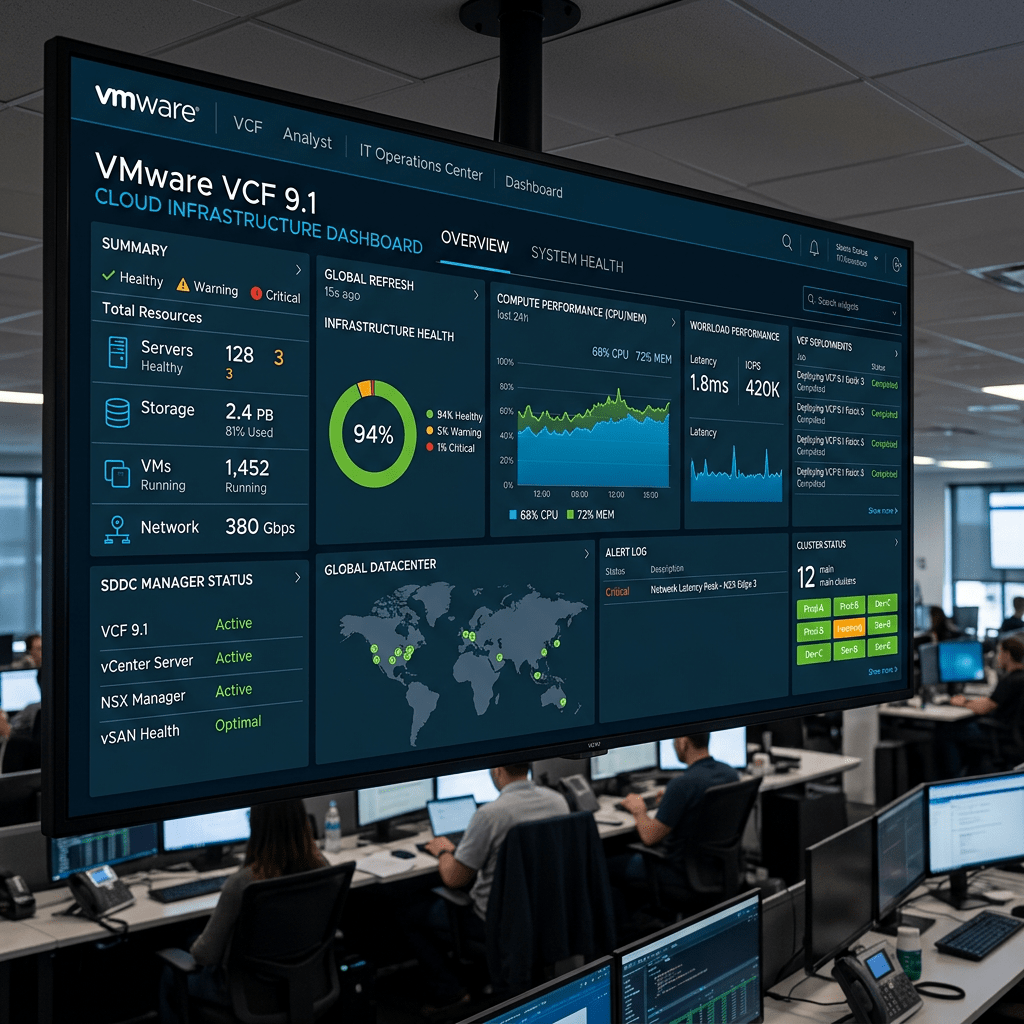
Daily Cloud Blog • First Impression
My First Impression of VMware Cloud Foundation 9.1: Private Cloud Is Becoming the AI Control Plane
VMware Cloud Foundation 9.1 is not just another platform release. My first impression is that Broadcom is positioning VCF as a serious private cloud foundation for production AI, modern applications, data sovereignty, security, and enterprise cost control.
Author: Christian Marrero Bonilla
Blog: Daily Cloud Blog
Topic: VMware Cloud Foundation 9.1, Private Cloud, AI Infrastructure, Enterprise Cloud
First Impression
After reading VMware’s announcement on VCF 9.1: The Secure, Cost-Effective Private Cloud Platform for Production AI, my first reaction is simple: VMware is clearly trying to redefine the private cloud conversation around AI, security, sovereignty, and operational efficiency.
For years, many organizations looked at public cloud as the default path for innovation. But with AI workloads growing, data governance becoming more complex, and infrastructure costs getting harder to control, the private cloud is becoming relevant again — not as legacy infrastructure, but as a strategic platform.
My Take
VCF 9.1 feels like VMware’s message to enterprise IT: you can run AI, containers, virtual machines, modern apps, and traditional workloads under one private cloud operating model without giving up security, governance, or cost discipline.
Why This Release Matters
The article highlights three major forces shaping enterprise infrastructure in 2026: AI demand, geopolitical and data sovereignty pressure, and budget compression. That combination is very real for enterprise IT teams. Businesses want AI capabilities, but they also need to protect sensitive data, control where workloads run, and avoid uncontrolled cloud spending.
This is where VCF 9.1 becomes interesting. Instead of treating private cloud as only a virtualization platform, VMware is presenting it as a production-ready cloud platform for AI-enabled workloads, Kubernetes, databases, ransomware recovery, compliance, and infrastructure automation.
AI on Private Cloud Is the Big Message
One of the strongest parts of this announcement is the focus on production AI. Many organizations are experimenting with AI, but moving from proof of concept to production is much harder. Production AI requires GPU visibility, performance monitoring, data control, cost management, and security from day one.
VCF 9.1 introduces capabilities such as Private AI model and GPU metrics, enhanced DirectPath I/O for newer AMD GPUs, and topology-aware scheduling. From an infrastructure perspective, that matters because AI workloads are not just “another VM.” They are resource-heavy, latency-sensitive, expensive, and often tied to sensitive data.
Key AI Infrastructure Takeaway
If VMware can make GPU-backed private cloud easier to operate, monitor, and secure, VCF could become a strong option for enterprises that want AI capabilities without moving every sensitive workload into the public cloud.
Cost Control Is Front and Center
Another major theme is cost efficiency. VMware mentions features like Enhanced NVMe Memory Tiering, extended vSAN deduplication and compression, larger fleet scale, and operational observability. These are not flashy features, but they are important for real enterprise environments.
In my opinion, this is where VMware needs to win back confidence. Many customers are carefully evaluating the cost of VMware licensing, hardware refreshes, public cloud alternatives, and hybrid cloud strategies. If VCF 9.1 can help organizations drive more workload density, improve resource utilization, and simplify operations, that becomes a strong business case.
Security and Ransomware Recovery Stand Out
The security improvements are another area that caught my attention. VCF 9.1 places strong emphasis on ransomware recovery, encrypted vMotion, continuous compliance enforcement, live patching for TPM-enabled hosts, and lateral security controls.
This is important because private cloud environments are often running mission-critical systems. If those systems support AI models, regulated data, healthcare workloads, financial systems, or government services, security cannot be an add-on. It has to be part of the platform architecture.
Security First Impression
VCF 9.1 appears to be moving security from a separate operational task into a continuous platform capability. That is the right direction for modern private cloud.
Application Delivery Looks More Modern
Another positive sign is the focus on application delivery. VMware highlights VKS scale improvements, VM Fast-Deploy, simplified Container-as-a-Service, Tanzu Marketplace integration, SQL Server DBaaS, native object storage preview, and application stack blueprints.
This tells me VMware understands that enterprise platforms can no longer be focused only on virtual machines. Developers and platform teams need Kubernetes, databases, object storage, automation, blueprints, and self-service capabilities. The closer VCF gets to a true internal cloud platform, the more valuable it becomes.
My Honest Opinion
My honest first impression is that VCF 9.1 is a strong step in the right direction. It feels more aligned with where enterprise IT is going: hybrid cloud, private AI, secure infrastructure, automation, compliance, and cost visibility.
However, the real test will be execution. Customers will want to know how simple the upgrade path is, how licensing and cost compare against alternatives, how mature the AI capabilities are in production, and how easy it is to operate this platform at scale.
What I Like
Strong focus on private AI, GPU visibility, ransomware recovery, compliance, and unified operations.
What I’m Watching
Cost model, upgrade complexity, licensing impact, operational simplicity, and ecosystem adoption.
Best Fit
Enterprises needing secure private cloud, AI workloads, data sovereignty, Kubernetes, and traditional VM support.
Final Thoughts
VCF 9.1 reinforces a major trend: private cloud is not dead. In fact, for many organizations, private cloud may become the preferred platform for sensitive AI, regulated workloads, and business-critical applications.
Public cloud will continue to be important, but not every workload belongs there. The future is hybrid, and platforms like VMware Cloud Foundation are being positioned to give organizations more control over cost, security, data, and infrastructure strategy.
My first impression: VCF 9.1 is VMware’s strongest statement yet that the private cloud has a major role to play in the AI era.
Need Help Planning Your Private Cloud or Hybrid Cloud Strategy?
MB Technology Group LLC helps organizations evaluate, design, and modernize cloud, infrastructure, virtualization, and data center platforms.
Daily Cloud Blog — Practical insights on cloud, infrastructure, virtualization, cybersecurity, and enterprise technology modernization.


Leave a Reply