
Cloud Infrastructure | Private Cloud | Architecture
How to Create Your Own Cloud Platform
Building your own cloud does not mean competing directly with AWS or Azure. It means creating a private cloud platform that gives you control over compute, storage, networking, automation, and self-service infrastructure.
Many IT professionals and architects eventually ask the same question: Can I build my own cloud? The answer is yes — but it is important to define what that really means. Creating your own cloud is not about replacing hyperscalers. Instead, it is about designing and operating a private cloud environment that delivers many of the same benefits: virtualization, automation, self-service provisioning, scalable storage, network isolation, and centralized management.
Whether you want to build a serious home lab, a hosted infrastructure platform, or the foundation for a future service offering, creating your own cloud is one of the best ways to sharpen your architecture skills and gain end-to-end control over your environment.
What “Building Your Own Cloud” Really Means
In practical terms, it means combining compute, storage, networking, identity, and orchestration into a platform that can host applications, virtual machines, containers, and services with centralized control and repeatable deployment.
Three Ways to Build Your Own Cloud
1. Home Lab or Private Cloud
This is the best starting point for most architects, engineers, and technology enthusiasts. You use your own servers, storage, and network equipment to create a private cloud environment inside your home lab or office.
- Run virtual machines and containers
- Create isolated networks and VLANs
- Provide shared storage for workloads
- Experiment with automation, HA, and orchestration
2. Hosted Private Cloud
The next step is deploying your platform on dedicated bare-metal servers from a provider such as Hetzner, OVHcloud, or other colocation options. This gives you a more production-like environment and opens the door to hosting real workloads or customer solutions.
- More reliable infrastructure than a home lab
- Better external connectivity
- Potential for hosted services or consulting platforms
3. Full Cloud Platform
This is the startup-level path. At this stage, your platform becomes multi-tenant, API-driven, and service-oriented. You add authentication, metering, policy controls, automation pipelines, and even billing or subscription features.
- Multi-user self-service portal
- Infrastructure APIs and Terraform integration
- Usage tracking and billing models
- Niche cloud services for specific industries or workloads
The Core Components of a Cloud Platform
To build a real cloud, you need more than just a hypervisor. A cloud platform is made up of several foundational layers working together.
Compute Layer
This is where workloads actually run. In most private cloud builds, this starts with virtualization and may later expand into container platforms.
- Proxmox VE – Excellent for labs and serious private cloud environments
- VMware ESXi / vSphere – Enterprise-grade virtualization
- KVM – Flexible and open-source foundation
- Kubernetes – For containerized platform services
Storage Layer
Storage is one of the most important design decisions in any cloud environment. You need reliable, scalable, and preferably redundant storage for virtual machines, container volumes, and backups.
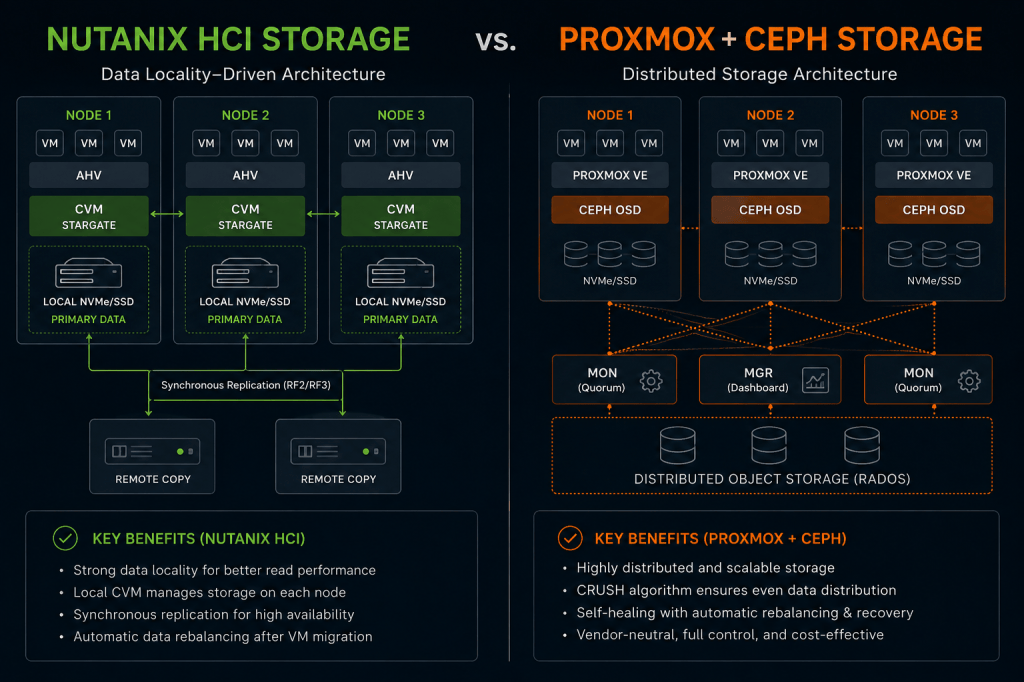
- Ceph – Distributed storage for block, file, and object workloads
- TrueNAS – Powerful NAS and shared storage platform
- ZFS-based storage – Great for snapshots, integrity, and performance
Networking Layer
Networking transforms a virtualization environment into a cloud-like platform. Segmentation, routing, remote access, and traffic distribution are all critical.
- VLANs and network segmentation
- WireGuard or OpenVPN for remote secure access
- HAProxy or NGINX for load balancing
- Open vSwitch for advanced virtual switching
Identity and Access
A real cloud needs centralized authentication and role-based access control.
- Keycloak for SSO and identity federation
- FreeIPA for directory services
- LDAP or Active Directory integration where needed
Management and Orchestration
This is the layer that makes your infrastructure feel like a real cloud instead of a collection of servers.
- OpenStack for full private cloud orchestration
- Apache CloudStack for cloud management and provisioning
- Terraform for Infrastructure as Code
- Ansible for configuration automation
A Practical Build Path
Phase 1: Build the Core
Start simple and build a stable private cloud foundation:
- Deploy 2–3 Proxmox nodes
- Add shared or distributed storage with Ceph or ZFS
- Create VLANs for management, storage, and workload traffic
- Secure remote access with WireGuard
- Implement backups and snapshots
Phase 2: Add Platform Services
Once the core is stable, expand into application delivery and automation:
- Deploy Kubernetes for containerized workloads
- Add ingress and load balancing
- Integrate CI/CD pipelines
- Use Terraform and Ansible for repeatable deployment
Phase 3: Create a Service Platform
At this level, your cloud becomes a true service platform:
- Self-service provisioning portal
- Multi-user role-based access
- API-driven infrastructure requests
- Monitoring, chargeback, or billing integrations
What Makes DIY Cloud Projects Fail?
The most common mistake is focusing only on virtualization while ignoring operations. A cloud is not just compute. It also requires discipline in monitoring, logging, backup, security, and lifecycle management.
- Monitoring: Prometheus, Grafana, alerts, and dashboards
- Logging: Centralized log collection and retention
- Backup and DR: Proven restore capability, not just backups
- Security: Hardening, MFA, patching, and least privilege
- Automation: Reduce drift with Infrastructure as Code
Best Use Cases for Your Own Cloud
Building your own cloud can create real value beyond the lab. Here are a few practical directions:
- Private hosting platform for client workloads
- Secure development and testing environments
- Cybersecurity lab infrastructure
- Hybrid-cloud extension for specialized workloads
- Niche hosting service for SMB or regulated environments
My Take
If you are serious about cloud engineering, platform architecture, or building a future product, creating your own cloud is one of the best hands-on projects you can take on. It forces you to think like both an engineer and an operator — which is exactly where real platform maturity starts.
Final Thoughts
Creating your own cloud is not about replacing hyperscale providers. It is about building a platform you control — one that teaches you how compute, storage, networking, identity, automation, and operations come together to deliver real services.
Start small, design intentionally, and build in layers. A solid private cloud can evolve from a lab into a serious platform, and in the right hands, even into a business opportunity.
Stay Connected with Daily Cloud Blog
If you found this comparison helpful, follow Daily Cloud Blog for more practical content on cloud, virtualization, DevOps, cybersecurity, and infrastructure strategy.
We regularly share technical breakdowns, architecture guidance, and real-world insights designed for engineers, architects, and IT leaders.
Want more posts like this? Subscribe for fresh content on AWS, Azure, Kubernetes, virtualization, and modern infrastructure trends.
About Daily Cloud Blog
Daily Cloud Blog shares practical insights on cloud, virtualization, infrastructure, and modern IT strategy for engineers, architects, and technology leaders.


Leave a Reply